

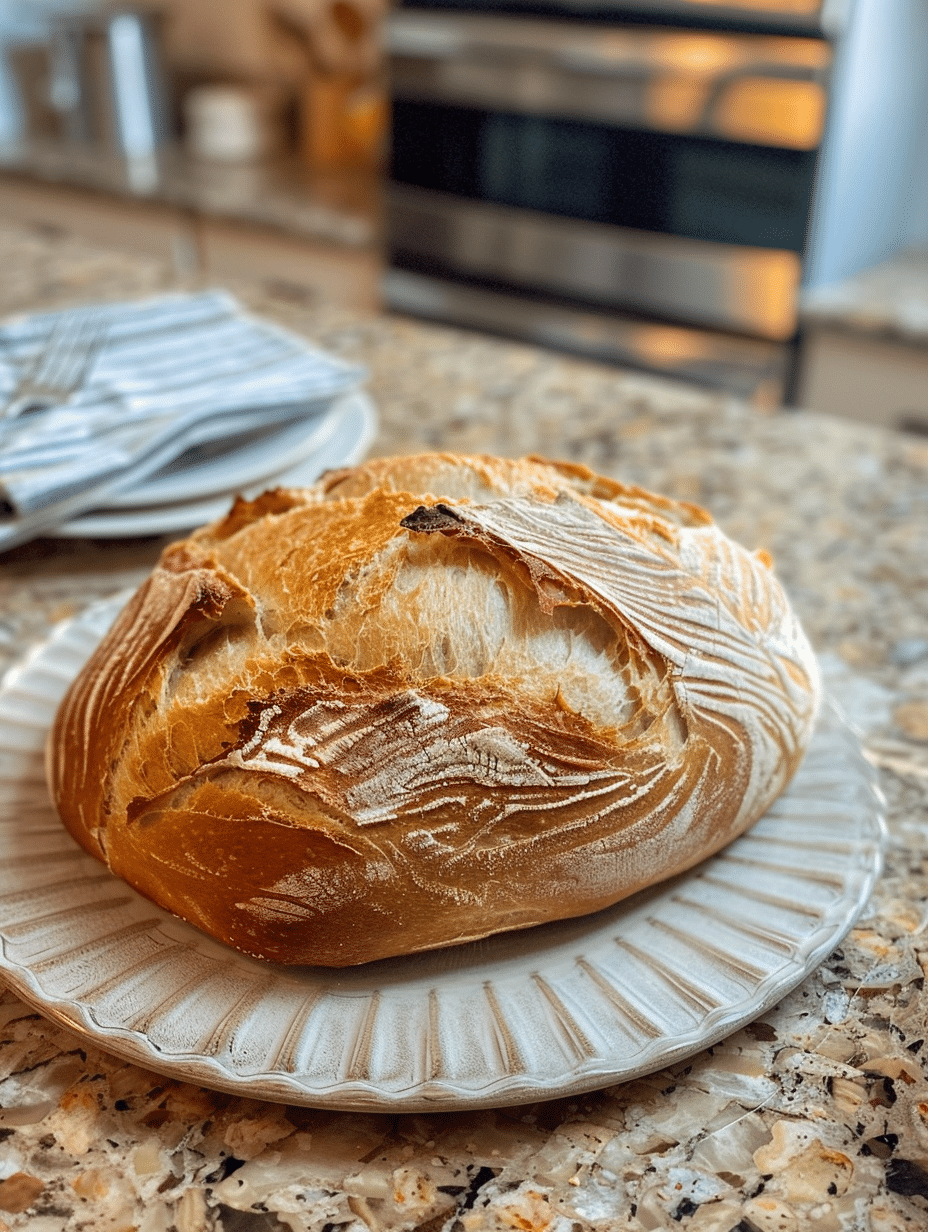
Homemade bread is a simple combination of flour, water, salt, and yeast that transforms into a warm, crusty loaf through time and technique. Making bread at home requires no special equipment, just patience and understanding of how gluten develops and fermentation works. This recipe produces a beautiful artisan-style loaf with a crispy crust and soft, airy crumb that rivals any professional bakery. Whether you are baking for the first time or refining your technique, this guide walks you through every step with precision and confidence.

Author and Brand Story
I am Eva Stoner, creator of Fresh Recipes Corner, where I share straightforward recipes for everyday cooking. My passion for baking began in my grandmother’s kitchen, where I learned that exceptional bread doesn’t require complexity, only care and proper technique. She taught me that bread is a conversation between baker and dough, where patience and attention reveal the most satisfying results. Those early mornings watching her shape dough and smell fresh loaves cooling shaped how I approach baking today. I started Fresh Recipes Corner to prove that anyone can bake professional-quality homemade bread at home with clear instructions and honest guidance.
Recipe Overview
| Attribute | Details |
|---|---|
| Prep Time | 15 minutes |
| Rise Time | 3 hours (bulk fermentation and shaping) |
| Bake Time | 35 minutes |
| Total Time | 3 hours 50 minutes |
| Servings | 8-10 slices (1 large loaf) |
| Difficulty | Intermediate |
| Cuisine | European Artisan |
| Yield | 1 standard loaf (500g) |
Why This Recipe Works
I developed this formula after years of testing different hydration levels, fermentation times, and shaping techniques to find the optimal balance for home bakers. The dough uses 75% hydration, which creates an open crumb structure without being so wet that it becomes impossible to handle or shape. Most beginners struggle with stiff, dense loaves because they fear high-hydration doughs, but this recipe teaches you to build confidence through proper technique rather than fighting the dough’s natural tendencies.
The long fermentation schedule allows flavors to develop deeply while gluten strengthens naturally through time instead of aggressive mixing. My experience in my grandmother’s kitchen taught me that slow fermentation produces better flavor and texture than quick methods using excessive yeast or aggressive kneading. This approach respects the ingredients and gives them space to express their true character, resulting in bread with complex flavor and superior keeping quality.
The combination of bulk fermentation followed by final proofing ensures your loaves rise reliably and bake with excellent oven spring and scoring definition. You will see a beautiful ear on your loaf when you score it properly before baking, and the crust will develop a deep golden-brown color with crispy texture that shatters when you bite into it. This recipe prioritizes results that build your confidence and skill with each bake.
Ingredients
| Ingredient | Quantity | Notes and Alternatives |
|---|---|---|
| Bread Flour (high protein) | 500g | Unbleached, 12%+ protein. All-purpose flour works but produces slightly less oven spring. Whole wheat can substitute 20% for nuttier flavor. |
| Water (filtered or tap) | 375ml | Temperature affects fermentation speed. 68-72°F (20-22°C) water is ideal. Warm water speeds fermentation; cold water slows it. |
| Sea Salt (fine) | 10g | Kosher salt works but adjust quantity to 12g for coarser crystals. Avoid iodized table salt which can inhibit yeast. |
| Instant Dry Yeast | 5g | Active dry yeast requires 25% more quantity (6.25g). Fresh yeast uses 15g. Sourdough starter (100g at 100% hydration) replaces commercial yeast entirely. |
| Olive Oil (optional) | 5ml | Adds richness and extends shelf life. Vegetable oil or omit entirely for a more rustic loaf with crispier crust. |
Step-by-Step Instructions
Mixing and Autolyse Phase
- Combine 500g bread flour, 375ml room-temperature water, and 5g instant yeast in a large mixing bowl.
- Mix with a wooden spoon or wet hands until all flour is hydrated and no dry streaks remain, about 1 minute of stirring.
- Cover the bowl with a damp cloth and let rest for 20-30 minutes at room temperature. This autolyse period allows flour to fully absorb water and gluten to begin developing naturally.
- Add 10g sea salt and 5ml olive oil to the dough after autolyse is complete.
- Mix thoroughly until salt is fully incorporated, using pincer motions with your fingers to fold the dough over itself repeatedly.
Bulk Fermentation Phase
- Cover the bowl and leave at room temperature for 4 hours total, performing stretch-and-fold sequences every 30 minutes for the first 2 hours.
- Execute a stretch-and-fold by wetting your hand, grabbing the dough from one side, stretching it up and over itself, then rotating the bowl 90 degrees and repeating four times total per sequence.
- After 2 hours of stretch-and-fold work, let the dough rest undisturbed for the remaining 2 hours of bulk fermentation.
- The dough is ready when it has increased in volume by 50-75% and feels airy with visible bubbles on the surface and sides.
- The dough should jiggle slightly when you shake the bowl and pass the poke test: pressing your wet finger into the dough leaves an indent that slowly springs back halfway.
Shaping Phase
- Dust your work surface lightly with flour and turn the dough out of the bowl using a bench scraper or your hand.
- Pre-shape the dough into a loose round by tucking edges underneath toward the center, then let it rest for 20 minutes on the bench.
- Perform final shaping by placing the dough seam-side up, then fold the top third down and press firmly to seal.
- Fold the left and right sides toward the center line and seal with your palm, creating tension on the surface.
- Roll the dough toward you tightly, sealing each rotation with the heel of your hand to create surface tension for oven spring.
- Place the shaped dough seam-side up in a floured banneton basket or bowl lined with a floured kitchen towel.
Final Proof and Bake Phase
- Cover the banneton with plastic wrap or a shower cap and refrigerate for 8-16 hours overnight, or let it proof at room temperature for 2-3 hours.
- Preheat your oven to 475°F (245°C) with a Dutch oven inside for 30 minutes to achieve excellent crust development.
- Turn the proofed dough onto parchment paper and score the top with a sharp knife or lame, creating a quarter-inch deep cut at a 45-degree angle.
- Carefully transfer the dough on parchment into the preheated Dutch oven, cover with the lid, and bake for 25 minutes to trap steam.
- Remove the Dutch oven lid and bake for an additional 10-12 minutes until the crust is deep golden brown and registers 205-210°F (96-99°C) internal temperature.
- Remove the bread from the oven and turn it out onto a wire rack to cool completely for at least 1 hour before slicing, allowing the crumb to set properly.
Chef Tips for Perfect Results
- Use a kitchen scale to measure ingredients by weight, not volume. Weighing flour and water ensures consistent results every bake, eliminating variables that cause home bakers to struggle with inconsistent loaves.
- Keep your dough at 75-78°F (24-26°C) during bulk fermentation for reliable timing. Colder kitchens require longer fermentation; warmer kitchens require shorter times. Use an instant-read thermometer to check dough temperature.
- Perform all stretch-and-fold sequences during the first half of bulk fermentation only. This builds gluten strength efficiently without overworking the dough into tight, dense crumb structure.
- Score your dough decisively with one smooth motion at a 45-degree angle, creating a quarter-inch deep cut. Hesitant or shallow scoring produces poor oven spring and prevents the characteristic “ear” from forming.
- Invest in a Dutch oven or high-quality covered baking vessel that traps steam effectively. Steam is essential for crust development and oven spring; baking on a regular baking sheet produces pale, thick crust.
- Bake your loaves on the lowest oven rack positioned near the heating element. This proximity to the heat source creates better bottom crust color and texture without risking a burnt bottom.
Common Mistakes to Avoid
Mistake 1: Overproofing the dough. Overproofed dough collapses during scoring and produces a dense, gummy crumb with minimal oven spring. The poke test reveals overproofing: your indentation does not spring back at all. Fix this by reducing final proof time by 30 minutes or placing dough in the refrigerator earlier to slow fermentation and ensure it is perfectly proofed when baking.
Mistake 2: Using water that is too warm or too cold. Water temperature above 75°F accelerates fermentation unpredictably; water below 65°F slows it excessively. This causes timing to fail and fermentation schedules to become unreliable. Always use 68-72°F water measured with an instant-read thermometer for consistency.
Mistake 3: Skipping the autolyse step. Mixing salt directly into the dough before autolyse inhibits yeast activation and prevents proper gluten development. The salt should be added after the 20-30 minute rest period when flour has fully hydrated and gluten has begun forming naturally.
Mistake 4: Insufficient stretch-and-fold work during early fermentation. Skipping or rushing stretch-and-fold sequences produces dough that cannot hold gas bubbles effectively, resulting in a dense, tight crumb with poor rise. Dedicate the first 2 hours of bulk fermentation to four sets of stretch-and-fold, spacing them 30 minutes apart for optimal gluten development.
Mistake 5: Opening the Dutch oven too early. Removing the lid before 25 minutes of baking allows steam to escape prematurely, reducing oven spring and producing thick, pale crust instead of crispy, caramelized exterior. Keep the lid on for the full 25 minutes without peeking, then bake uncovered for the final phase.
Variations and Substitutions
| Ingredient | Substitution | Impact on Flavor and Texture |
|---|---|---|
| Bread Flour (100%) | All-Purpose Flour (100%) | Produces slightly less oven spring and softer crumb due to lower protein content (10-12% vs 12-14%). Loaf remains delicious but slightly denser. |
| Instant Yeast (5g) | Sourdough Starter (100g at 100% hydration) | Dramatically increases complexity and sour flavor. Extends bulk fermentation to 6-8 hours. Creates superior shelf life and digestibility. |
| Water (375ml) | Whole Wheat Flour (20% substitution = 100g wheat flour, 400g bread flour) | Adds nuttiness, density, and nutritional depth. Requires 25ml additional water (total 400ml) due to higher bran absorption. Darkens crust significantly. |
| Plain Dough | Add 40g toasted seeds (sunflower, sesame, or pumpkin) to dough after autolyse | Creates textural contrast and toasted, earthy flavors. Reduces oven spring slightly but adds visual appeal and nutritional value. |
| Instant Yeast (5g) | Active Dry Yeast (6.25g) | Requires longer fermentation time by 15-20 minutes due to larger granule size and slower hydration. Final results are identical if fermentation is extended appropriately. |
| Sea Salt (10g) | Kosher Salt (12g) | Coarser crystals dissolve more slowly, requiring thorough mixing after addition. Final flavor is identical; texture of dough feels slightly different during mixing. |
Serving Suggestions and Pairings
Breakfast Service: Slice your homemade bread while still warm and serve with unsalted butter, honey, and fresh jam. Toast thick slices and top with cottage cheese, sliced tomatoes, and fresh herbs for a Mediterranean breakfast. Serve alongside soft-boiled eggs and olives for an elegant morning spread.
Lunch and Casual Dining: Use your cooled loaf for sandwiches layered with roasted vegetables, hummus, and fresh greens. Tear chunks and serve with olive oil and balsamic vinegar for dipping, or use as the foundation for bruschetta topped with tomatoes, garlic, and fresh basil.
Dinner Service: Break bread at the table before your main course with unsalted butter and sea salt. Serve alongside soups like minestrone, lentil, or tomato bisque. Use bread for soaking up flavorful sauces from roasted vegetables or stews.
Special Occasions: Present your freshly baked homemade bread as a hostess gift, wrapped in linen and still warm from cooling. Serve at holiday gatherings as proof of your baking skill and dedication to quality ingredients.
Snacking and Preservation: Toast day-old bread and spread with ricotta and honey, or layer with roasted peppers and olive oil for quick, satisfying snacks that keep well when refrigerated.
Storage and Reheating
| Storage Method | Duration | Instructions |
|---|---|---|
| Room Temperature (Bread Box) | 3-4 days | Wrap cooled loaf in clean cloth or store cut-side down on a cutting board. Keep in cool location away from direct sunlight. Crust softens gradually; interior dries slightly each day. |
| Refrigerator | 5-7 days | Slice cooled loaf and store in airtight container or wrapped tightly in plastic wrap. Refrigeration halts staling but can make crust less crispy. Toast slices before serving. |
| Freezer | 2-3 months | Slice cooled loaf, wrap tightly in plastic wrap, then aluminum foil, and label with date. Freeze in freezer-safe container. Thaw at room temperature for 1-2 hours before toasting. |
| Freeze Individual Slices | 2-3 months | Slice cooled bread, wrap each slice individually in plastic wrap, and freeze in labeled freezer bag. Toast directly from frozen without thawing for best results. |
| Oven Refresh (Day-Old Loaf) | N/A | Wrap entire loaf in damp cloth, place on baking sheet, and warm in 350°F (175°C) oven for 10-15 minutes until crust crisps and interior softens. Serve immediately while warm. |
| Toaster Oven Slice Refresh | N/A | Toast refrigerated or frozen slices at medium setting for 2-3 minutes until crust crisps and interior warms through. Serve with butter, jam, or your preferred topping immediately. |

Nutritional Information
| Nutrient | Amount per Serving (1 slice, 62g) |
|---|---|
| Calories | 165 |
| Protein | 5.2g |
| Total Fat | 1.1g |
| Saturated Fat | 0.2g |
| Carbohydrates | 33.8g |
| Dietary Fiber | 1.9g |
| Sugars | 0.6g |
| Sodium | 315mg |
| Potassium | 85mg |
| Iron | 2.1mg |
Approximate values based on USDA FoodData Central database for bread flour, water, yeast, and salt. Actual values vary based on specific brands and preparation methods. Yields approximately 8-10 slices per loaf.
Frequently Asked Questions
Can I substitute bread flour with all-purpose flour for homemade bread?
Yes, all-purpose flour produces acceptable homemade bread with slightly less oven spring and a softer crumb structure. All-purpose flour contains 10-12% protein compared to bread flour’s 12-14%, which reduces gluten development and results in a marginally denser loaf. Your bread will still be delicious and edible, but experienced bakers will notice the difference in rise and interior structure.
How do I know when my homemade bread dough is perfectly proofed?
Perform the poke test by pressing your wet finger into the dough about half an inch deep. Perfectly proofed dough shows an indentation that springs back halfway, leaving a slight dimple that doesn’t completely disappear. Underproofed dough springs back completely and instantly; overproofed dough remains indented with no spring-back at all.
Why is my homemade bread dense and gummy in the center?
Dense, gummy bread results from overproofing, underbaking, or insufficient gluten development through stretch-and-fold work. Verify that your oven temperature is accurate by using an oven thermometer, bake until internal temperature reaches 205-210°F, and ensure all four stretch-and-fold sequences occur during early fermentation. If problems persist, reduce final proof time by 30 minutes.
Can I make homemade bread dough ahead and refrigerate it overnight?
Absolutely, refrigerating shaped dough for 8-16 hours overnight improves flavor significantly through extended cold fermentation. Place shaped dough in a floured banneton, cover with plastic wrap, and refrigerate. Bake directly from cold without thawing, adding 5-10 minutes to bake time. Cold dough produces superior crust development and more complex flavor.
What is the best way to serve fresh homemade bread to guests?
Serve your homemade bread warm or at room temperature broken into chunks rather than pre-sliced, allowing guests to tear pieces as desired. Provide unsalted butter, good quality olive oil, and sea salt for dipping. Fresh bread is best enjoyed within 4 hours of baking when crust is crispiest and flavor is most vibrant.
How do I troubleshoot weak oven spring when baking homemade bread?
Weak oven spring results from overproofing, using yeast that has expired, water temperature that is too warm or cold, or insufficient scoring depth. Verify your yeast expiration date, measure water temperature precisely at 68-72°F, reduce final proof time by 15-30 minutes, and score decisively with a sharp blade at 45 degrees at quarter-inch depth. These adjustments restore reliable oven spring.
Conclusion
Homemade bread transforms simple ingredients into a warm, rewarding experience through patient fermentation and proper technique. This recipe prioritizes understanding over complexity, teaching you to read your dough and trust the process that built confidence in bakers for thousands of years. Your first bake will produce beautiful results, and each subsequent loaf deepens your skill and intuition. Embrace the rhythm of mixing, fermenting, shaping, and baking, and you will discover why fresh homemade bread remains one of life’s simplest and most satisfying pleasures.
For more guidance on bread baking and fermentation, visit King Arthur Baking Company’s Bread Resource Center or explore The Perfect Loaf for advanced techniques and variations. Continue baking and refining your craft at Fresh Recipes Corner, where simple, reliable recipes meet practical guidance for everyday cooking success.
Homemade Artisan Bread
Ingredients
- 300g bread flour (or all-purpose flour)
- 225g warm water (75% hydration)
- 10g fine sea salt
- 5g instant yeast
Instructions
- Combine flour, salt, and yeast in a bowl
- Add warm water and mix until no dry bits remain
- Let rest 10 minutes to hydrate
- Stretch and fold the dough 6-8 times, then cover and let bulk ferment 2 hours at room temperature
- Turn dough onto a floured surface and shape into a round loaf
- Place in a proofing basket, cover, and let rest 1 hour
- Preheat oven to 230°C (450°F) with a baking stone or large oven-safe pan
- Score the loaf and bake for 20 minutes, then reduce heat to 210°C (400°F) and bake 15 more minutes
Notes
Bulk fermentation can be extended in the refrigerator for deeper flavor
If dough feels sticky, add small amounts of flour when handling
Let bread cool completely before slicing to avoid gummy texture